SuperMimic: Scaling Humanoid Whole-Body Control with One Differentiable World Model¶
Session: CoRL 2026 oral. Reported as the Best Paper Award winner. Secondary reports say the awards were announced on Nov 11; corl.org's awards page didn't list winners when checked. In the Isaac Lab 3.0 tech session on Day 3, it appeared in the list of world-model workloads (see the Day 3 notes). Paper: arXiv 2610.28480 (v2, Nov 9, 2026) by Qiayuan Liao, Yiyang Shao*, Junfeng Long*, Kevin Zakka, Roberto Horowitz, Pieter Abbeel†, and Koushil Sreenath† (UC Berkeley). *Equal contribution. †Equal advising. Project page: supermimic.github.io, with a video and an in-browser demo. No code or weights are linked as of Nov 12, 2026.
Paper summary (from the abstract, the project page, and the PDF's method, conclusion, and limitations sections)¶
- Problem: Tracking large human-motion datasets is the main route to general, expressive humanoid whole-body control, but scaling to many motions is expensive. Current pipelines use model-free RL. They either merge per-motion specialists through lossy distillation, or brute-force one policy with cluster-scale compute.
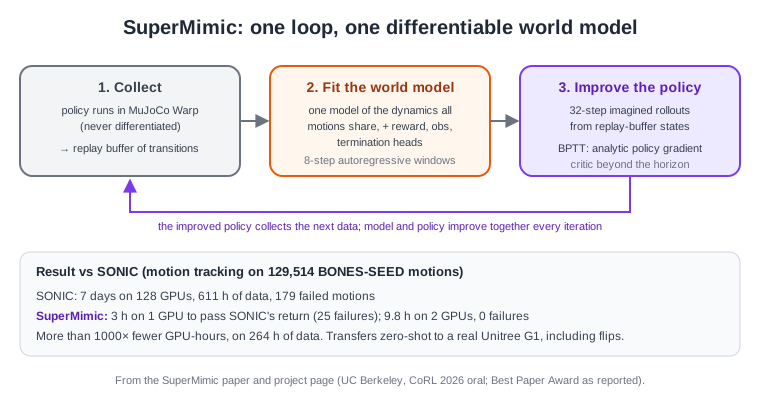
- Method: one differentiable world model for all motions. Training alternates three phases in one loop:
- Collect: The current policy runs in a standard rigid-body simulator, MuJoCo Warp, and the transitions go into a replay buffer. SuperMimic never differentiates the simulator.
- Fit the world model: It learns the dynamics every motion shares, plus reward, observation, and termination heads. It's fit on 8-step autoregressive windows from the replay buffer and conditioned on per-episode sim context (friction, calibration offsets, torso center of mass). It predicts a termination probability, so the survival weight stays differentiable.
- Improve the policy in imagination: With the world model frozen, it rolls out 32 steps from replay-buffer states and backpropagates the imagined return through the model. That gives analytic policy gradients (BPTT). A critic estimates the return beyond 32 steps.
- The world model updates every iteration, so dynamics learning and control improve together.
- Controller: a deterministic goal-conditioned policy outputting normalized joint setpoints at 50 Hz. The reward is the BeyondMimic motion-tracking reward. Other goal interfaces, such as velocity commands, share the same learned dynamics.
- Data: 264.56 hours of BONES-SEED (the public subset). The baseline, SONIC, used the full 611 hours, 2.3× more.
- Results:
| SONIC (baseline) | SuperMimic | |
|---|---|---|
| Compute | 7 days on 128 L40 GPUs (~21,000 GPU-hours) | 3 h on 1 H100 to pass SONIC's return |
| Failed motions, of 129,514 | 179 | 25 (1 GPU, 3 h); 0 (2 GPUs, 9.8 h) |
- Speedup: more than 1000× fewer GPU-hours and more than 50× less wall-clock time.
- Hardest motion groups, with SONIC's failures vs SuperMimic's at 1 GPU and 3 h: side rolls 22 of 22 vs 2; flips 44 of 44 vs 1; dance routines 8 of 8 vs 0.
- Scaling: From 1 to 264 hours of motion, world-model prediction error stays at 0.007–0.011, and the GPU-hours needed to reach a target return grow slowly.
- Imagination: more than 10× faster than MuJoCo Warp at the batch sizes used. Analytic gradients need about 64× fewer imagined steps than PPO on the same world-model rollouts.
- Horizon: A 16-step horizon with the critic matches a 32-step horizon without it. Without the critic, training fails at 16 steps or fewer.
- Real robot: One general motion tracker transfers zero-shot to a physical Unitree G1, including skipping jumps, side rolls, and 90° and 360° flips. The project page gives no real-robot success rates.
- Caveats the authors note: The benchmark motions are training motions for both methods, so failure counts measure coverage, not generalization. The two runs also differ in data and hardware, though the authors argue that 2.3× less data and at most 5.5× more peak GPU throughput can't explain a 1000× gap.
- Limitations (as stated):
- Multi-interface training is understudied. The velocity-tracking reward updates only the velocity encoder, not the shared decoder.
- The world model learns only from simulator transitions. Real-robot data could refine it, and its differentiability could support system identification.
- It trains only on flat ground, with no terrain or object interaction yet.
Talk notes¶
- In the Day 3 Isaac Lab 3.0 tech session, it was listed with Cosmos as a world-model workload running on Isaac Lab.
Questions / discussion¶
- This is the "world model as simulator" role from the world-models theme, but for low-level control. The model is fit to a physics simulator, not to real video.
- Compare with SONIC, which was also listed as an Isaac Lab workload on Day 3. Same task, about 1000× less compute.