CoRL 2026 Conference Digest
By Karthik Pythireddi
A digest of the talks, papers, and cross-cutting themes from the Conference on Robot Learning (CoRL 2026), Austin, Texas, November 9–12, 2026.
About the conference (from corl.org):
- Dates: Main conference November 9–11, 2026, and workshops on November 12.
- Venues: Hilton Austin for presentations and keynotes on Days 1 and 2. JW Marriott Austin for poster sessions, exhibits, lunch, and breaks. Bass Hall for the reception and the Day 3 keynote.
- Program: 32 accepted workshops, and a demo track that requires a physical robot system.
- Awards (reported in press coverage): Best Paper, SuperMimic (UC Berkeley). Best Student Paper, RoboTTT (NVIDIA GEAR, Stanford, UT Austin).
- Scale (reported in press coverage; not published on corl.org): about 2,094 submissions and 687 accepted papers, an acceptance rate of about 33%.
CoRL 2026 at a glance
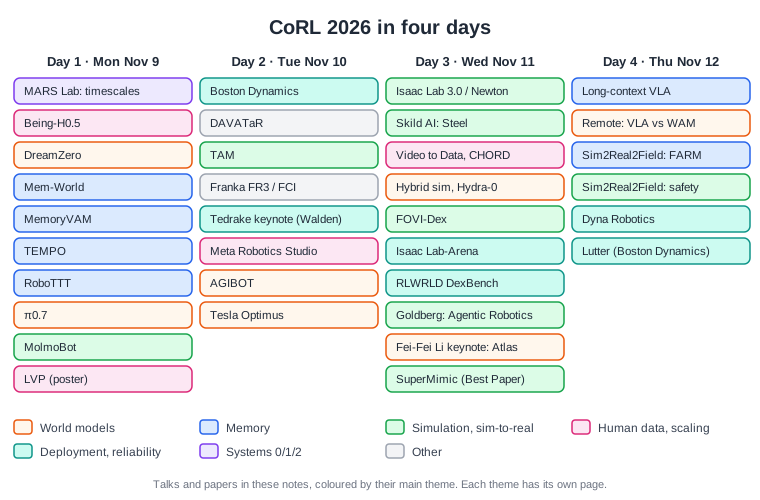
Six themes ran through the week. Each page pulls together the talks across all four days, with tables and diagrams:
| Theme | The one-line version | Page |
|---|---|---|
| World models | Used three ways: as the policy (DreamZero, Dyna-2), as a simulator (Tesla, Hydra-0, Atlas), and as a planner (π0.7, LVP). A Day 4 workshop argued you may not need one. | World models and world action models |
| Memory and long context | Single-frame policies aren't enough. Memory ranged from history tokens and fast weights to text summaries and 3D object graphs. | Memory and long context |
| Simulation and sim-to-real | Isaac Lab 3.0 and Newton, Steel, and Arena for heterogeneous robots. Agents now build the sim from real video. Demo resets make RL practical for dexterity. | Simulation and sim-to-real |
| Human data and scaling | From 12 minutes (DreamZero) to 1M+ hours (Dyna-2) of human video. The hard part is mapping human motion onto robots. | Human data and scaling |
| Deployment and reliability | 99% per step finishes only 45% of a 79-step job. Industry talks were about recovery, fleet health, interventions, and diagnostic evaluation. | Deployment and reliability |
| Systems 0 / 1 / 2 | Most stacks split a slow planner from a fast policy. They differ in the interface between them. The feedback path back up is mostly missing. | Systems 0 / 1 / 2 |
Days
| Day | Date | Papers | Talks |
|---|---|---|---|
| Day 1 | Mon 2026-11-09 | 9 | 5 |
| Day 2 | Tue 2026-11-10 | 2 | 8 |
| Day 3 | Wed 2026-11-11 | 3 | 9 |
| Day 4 | Thu 2026-11-12 | 3 | 6 |
Talks and sessions
Every talk and session in these notes, including industry and tech sessions that have no paper file.
Papers
Status: talk-only: 3 · abstract: 5 · summarized: 8
| Paper | Day | Group | Headline | Status | Links | Weights |
|---|---|---|---|---|---|---|
| Being-H0.5 | 1 | BeingBeyond | 35k h across 30 embodiments with a unified action space; 98.9% LIBERO | abstract | arXiv · page | ? |
| DreamZero | 1 | NVIDIA | 14B video model as policy; over 2× generalization vs VLAs at 7 Hz | summarized | arXiv · page · code | ✅ |
| LVP | 1 | MIT, UC Berkeley, Harvard | 14B video planner for zero-shot robot control; 59.3% task completion on 100 third-party tasks vs Wan 2.1, Hunyuan, Cosmos | talk-only | page | ? |
| Mem-World | 1 | Future actions pick which history a multi-view world model retrieves, via a wrist-view 4D surfel memory | talk-only | ? | ||
| MemoryVAM | 1 | UCLA, UCSD, Utah, Nirvana Robotics | LIBERO-Mem from 5% to 42.5%; 75–80% on real memory tasks | summarized | arXiv · page | ? |
| MolmoBot | 1 | Ai2 | Sim-only training; 79.2% real pick-and-place vs 39.2% for π0.5 | abstract | arXiv · page | ? |
| RoboTTT | 1 | NVIDIA GEAR, Stanford, UT Austin | 8K-step context at constant per-step cost; 79% vs 42% task completion | summarized | arXiv · page | ? |
| TEMPO | 1 | UC Irvine | Motion and command history for +2M parameters; 47.5% to 76.0% average success | summarized | arXiv · page · code | — |
| π0.7 | 1, 4 | Physical Intelligence | Metadata turns low-quality data from harmful to helpful; zero-shot UR5e shirt folding at teleoperator level | summarized | arXiv · page | — |
| DAVATaR | 2 | UT Austin | Fluidic tactile and immersion-depth sensing plus glare and zoom augmentation; 71% vs 41% mean success without tactile | summarized | page | ? |
| TAM | 2 | Ai2, KAIST | Sim-only residual torque layer below any policy; real Panda box pushing 47.6% to 76.2%, BC flip 50% to 72% | summarized | arXiv · page · code | ✅ |
| GaP | 3 | UC Berkeley, NVIDIA, Bosch | Coding agents self-learn a graph of modular skills in a Newton Real2Sim, then export plain ROS 2 code; no frontier model runs on the robot | abstract | arXiv · page · code | ? |
| Hydra-0 | 3 | NVIDIA, Brown, Columbia, Harvard | World model conditioned on action flow (robot actions as pixel motion); runs as a hybrid simulator, with physics for the robot and video for the world | talk-only | page | ? |
| SuperMimic | 3 | UC Berkeley | One learned world model + analytic gradients; beats SONIC's return in 3 h on 1 GPU vs 7 days on 128 GPUs (>1000× fewer GPU-hours) | summarized | arXiv · page | ? |
| Dyna-2 | 4 | Dyna Robotics | World-action model pre-trained on 1M+ hours of human video only; zero-shot robot action MSE 0.180 to 0.117 from 1k to 1M hours | abstract | page | ? |
| FARM | 4 | UC Berkeley, Stanford | Real-time object-level relational 3D memory answers relational language queries; +164% Recall@5 over prior methods (unverified) | abstract | arXiv · page · code | ? |
Status levels: stub means a title only. talk-only means talk notes with no paper summary. abstract means a summary from the abstract and secondary sources. summarized means the paper's HTML or text was read. read-pdf means the full PDF was read, including the figures.
By tag
| Tag | Papers |
|---|---|
cross-embodiment |
Being-H0.5, DreamZero, Hydra-0, LVP, π0.7, TAM |
video-model |
DreamZero, Dyna-2, Hydra-0, LVP, MemoryVAM, Mem-World |
simulation |
GaP, Hydra-0, MolmoBot, SuperMimic, TAM |
vla |
Being-H0.5, MolmoBot, π0.7, RoboTTT, TEMPO |
human-data |
Being-H0.5, DreamZero, Dyna-2, LVP |
sim-to-real |
GaP, MolmoBot, SuperMimic, TAM |
temporal-context |
MemoryVAM, π0.7, RoboTTT, TEMPO |
world-action-model |
DreamZero, Dyna-2, Hydra-0, MemoryVAM |
memory |
FARM, MemoryVAM, Mem-World |
system-0 |
SuperMimic, TAM |
agentic-robotics |
GaP |
data-augmentation |
DAVATaR |
dynamic-manipulation |
TEMPO |
generalist |
π0.7 |
humanoid |
SuperMimic |
steerability |
π0.7 |
submerged-manipulation |
DAVATaR |
system-1 |
DreamZero |
tactile |
DAVATaR |
test-time-training |
RoboTTT |