Being-H0.5: Scaling Human-Centric Robot Learning for Cross-Embodiment Generalization
Session: Not recorded. Slide photos taken Mon Nov 9, 10:49–10:54 am. Speaker(s): Paper: arXiv 2601.12993 (PDF) by Hao Luo et al. (BeingBeyond), January 2026 Project page: research.beingbeyond.com/being-h05
Paper summary (from the abstract and secondary sources; full PDF not yet read)
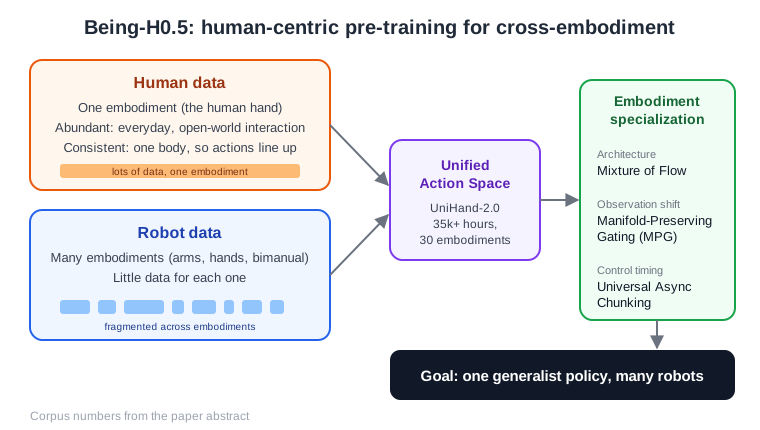
- Core idea: A VLA that treats human hand motion as a training signal shared across robots. It targets two problems with current VLAs: robots that differ in body shape and too little data for each robot.
- Data: The UniHand-2.0 pre-training corpus has more than 35,000 hours of multimodal data covering 30 robot embodiments.
- Unified Action Space: Each robot's controls map into a shared set of action slots, so robots with little data can learn from human data and from better-resourced platforms.
- Results: The paper reports state-of-the-art results in simulation: 98.9% on LIBERO and 53.9% on RoboCasa. A secondary summary says it beats π0.5 on real-robot bimanual tasks.
Talk notes
Corpus, action-space, results, and takeaways below come from slide photos. Bar values were read off the photos.
Why human-centric learning?
- Goal: One generalist policy that works across many embodiments.
- Robot data: Many embodiments, but little data for each one.
- Human data: One embodiment, with plenty of interaction data.
Advantages of human data
- Abundance: People interact with objects every day, all over the open world.
- Consistency: It all comes from a single embodiment.
Human-centric data as the pre-training corpus
- The slide's framing: Human demonstrations define the interaction domain, and robot data instantiates it on specific embodiments.
- Size: 35K hours, 400M samples, and 120B tokens. It splits into three parts:
- Human demonstrations: 16K hours, across lab setups, daily life, and industrial scenes. Used for multitask motion alignment (generating, describing, and continuing motion) and for semantics at several granularities, from chunk-level intent down to fine-grained actions.
- Robot manipulation: 14K hours, over 30 robot embodiments, with multiple camera views and several kinds of control signal.
- Vision-text understanding: 5K equivalent hours. Covers general visual QA, 2D spatial grounding and affordance, and task planning and reasoning.
- Role of each source:
- Human data: interaction priors, meaning dense priors on contact, causality, and manipulation.
- Robot data: embodiment grounding, meaning precise, executable control on each embodiment.
- Vision-language data: reasoning, meaning instruction following, planning, and spatial reasoning.
Unified action space and sequence modelling
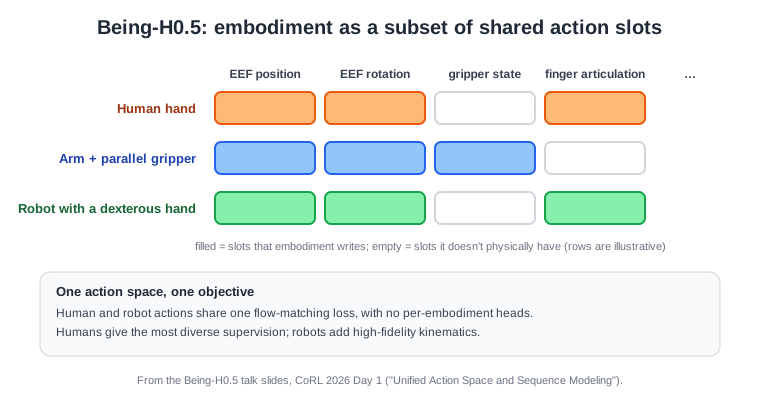
- Human and robot data share one action space and one training objective.
- Embodiment as a slot subset: The human hand and each robot write only the slots they physically have, such as end-effector position and rotation, gripper state, and finger articulation.
- Architecture: An understanding expert and an action expert, each with its own FFN and QKV, joined by shared attention. Repeated for N blocks.
- Shared action target: Human and robot actions share one space and one flow-matching loss, with no per-embodiment heads.
- Human-centric supervision: Humans provide the most diverse supervision, and robots add high-fidelity kinematics.
- Training tasks:
| Source | Task | Context → target | Loss |
|---|---|---|---|
| Human | Generation | vision, text, state → continuous action and motion tokens | flow matching + mask |
| Human | Description | vision, action → text | text |
| Human | Continuation | vision, past action → future action and motion tokens | flow matching + mask |
| Robot | Action prediction | vision, text, state → continuous action | flow matching |
| Vision-language | Text prediction | vision, text → text | text |
Effects of human-centric pre-training (real-robot ablations and transfer tests)
- Positive co-training transfer. Same architecture and post-training, overall success (%):
| Specialist | Generalist | |
|---|---|---|
| With pre-training | 68.6 | 66.4 |
| From scratch | 45.5 | 36.4 |
"Embodiments share skills instead of competing." 2. Unseen task-embodiment pairs. Tasks were collected only on G1 and run on Adam-U. From scratch, both tasks score 0. Being-H0.5 scores 20 on Close Box and 15 on Flip & Scan. "Skills are not tied to the source embodiment." 3. Robustness to environment shift. The same checkpoint runs on Adam-U with no retraining for shifted scenes (changed lights, backgrounds, and objects). Hand-over drops from 65 to 50, and Clear Table from 85 to 70. "Skills are not tied to the training scene."
Talk takeaways
- Human data anchors the shared prior. Mapped into the robots' action space, human video gives the broadest supervision, and robot data adds precise kinematics.
- Each robot specializes the shared prior. It occupies a subset of the shared action slots, and post-training adapts it to that robot's dynamics, observations, and timing.
- One checkpoint serves many embodiments. It nearly matches per-robot specialists, and the gap widens sharply without human-centric pre-training.
Embodiment specialization
- Architecture: Mixture of Flow
- Observation shift: Manifold-Preserving Gating (MPG)
- Control timing: Universal Async Chunking
Takeaways for our work
- With pre-training, the generalist is within about 2 points of the specialist (66.4 vs 68.6). From scratch the gap is about 9 points (36.4 vs 45.5). So pre-training is what makes one shared checkpoint viable.