Mem-World (full title not recorded)
Session: Not recorded. The slide photo was taken at 11:25 am on Mon Nov 9, shortly after the DreamZero talk (Oral Session 2, Talk 1). Speaker(s): Paper: Not yet found. The name comes from the slide footer, "Mem-World."
Paper summary
Not yet found. Everything below is from one slide photo (slide 6 of 15).
Talk notes
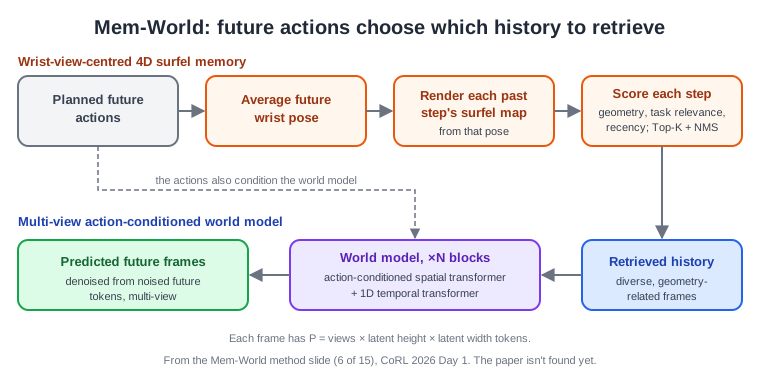
Method: let future actions determine which history to retrieve.
- Wrist-view-centred 4D surfel memory module:
- A surfel-based memory index covers every past timestep.
- The planned actions give a new end-effector pose and a new wrist camera pose.
- From that pose, the memory renders a surfel map for each past timestep, with depth, normals, timestep, and the manipulated object.
- A scorer rates each past timestep on geometry, task relevance, and recency. Top-K plus non-maximum suppression (NMS) then picks a diverse set of history frames.
- The slide's summary: "Actions → average future wrist pose → render each historical timestep separately."
- Multi-view action-conditioned world model:
- Its input is the retrieved, geometry-related history frames, followed by noised future frames.
- Each frame has P = v × h × w tokens, where v is the number of camera views and h and w are the latent height and width.
- Each of the N blocks has an action-conditioned spatial transformer followed by a 1D temporal transformer.
Questions / discussion
- How does this compare with MemoryVAM, the other Day 1 memory work?